Save Tweets as Tasks: Stop Losing What X Teaches You
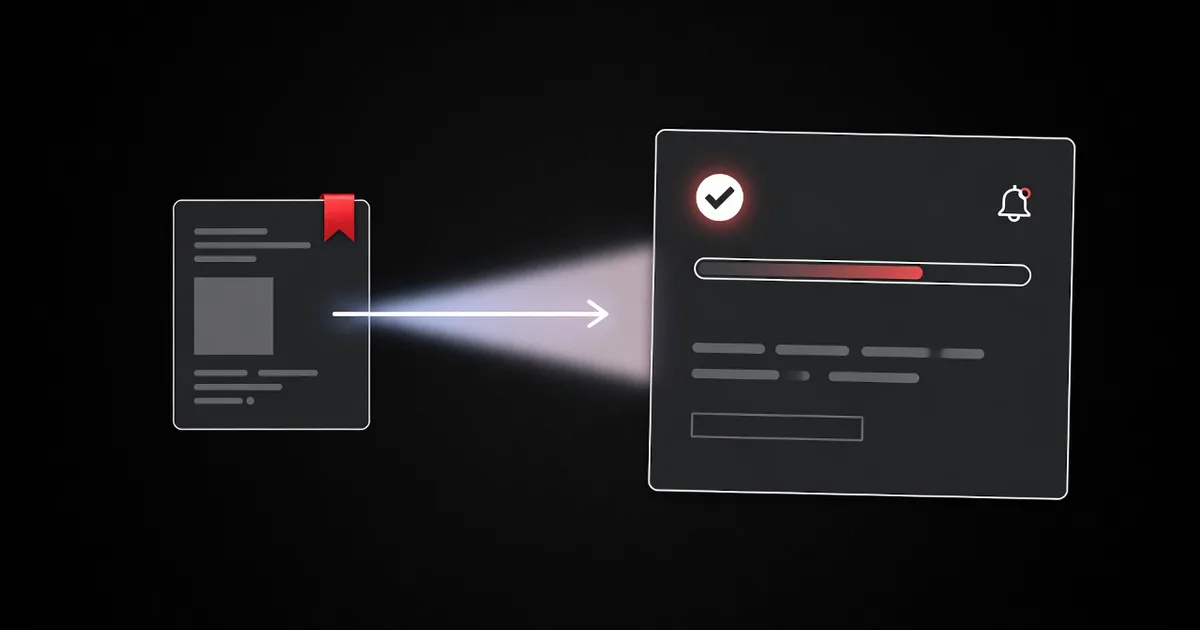
You bookmarked that thread about pricing your product because you meant to redo your pricing page. That was in March. The thread is still in your X bookmarks, the pricing page is still wrong, and both facts are connected. Saving a tweet records that something mattered. Only a task records what you meant to do about it, and the gap between those two is where most of what X teaches you quietly disappears.
The fix is a small habit: at the moment you save a tweet, decide the action it implies. This guide gives you the workflow, the three-line format that makes a tweet actionable, and the honest reasons the bookmarks folder alone has never once worked for anyone.
Why the bookmarks folder is a dead end
X bookmarks are genuinely good at what they do. They are private, the author never gets notified, and the official bookmarks feature keeps everything in one place with no social pressure attached. As pure storage, no complaints.
The problem is what storage does to intent. A bookmark strips the context you had at the moment of saving: why it mattered, what it connected to, what you meant to do. Three weeks later the thread is still there but you are a different person in a different week, and re-deriving "why did I save this?" costs more attention than most bookmarks ever repay. So the folder grows. Scrolling it starts to feel like homework. Eventually you save things into the pile precisely because the pile is where obligations go to stop nagging you.
That failure mode is not a discipline problem. It is a structural one: a bookmark holds content, and content is not a plan. The content-to-task idea exists exactly because those are different objects.
The three-line rule for saving a tweet
When a tweet is worth more than a like, capture three lines with it, at save time, while your reason still exists:
- Action: the next thing you will do because of this tweet. A verb, an object. "Rewrite the pricing page's first section."
- Source: the tweet itself, kept attached, so the receipts are one tap away when you act.
- Review: when this should resurface. A real date, not "later."
This is the same rule that works for screenshots and Reddit threads; tweets are just the format you save most often.
The workflow in practice
Save with intent, not reflex. Bookmark freely while reading; that part is cheap. Then, once a day at most, sweep the new saves and apply the three-line rule to each one. Most saves fail the action test and get archived without guilt. The few that pass become tasks. This split matters because judging every tweet mid-scroll breaks reading, while a two-minute daily sweep does not.
Keep the thread attached to the task. A task that says "try the cold-outreach template" is useless if the template lives in a thread you can no longer find. The source link is not decoration; it is the half of the task you cannot reconstruct from memory.
Give every task a return date. A tweet-task with no review date is a bookmark with extra steps. Most tweet-derived actions are small experiments, so a date inside the next two weeks is usually honest. Anything further out belongs in a someday list you review monthly.
Let the list stay short. Ten tweet-tasks you act on beat four hundred bookmarks you fear. If the sweep keeps producing more tasks than you finish, raise the bar on the action line, not the hours in your day. The point of the system is doing, not archiving.
Turn one saved tweet into a task with Glean
Glean is built for exactly this handoff. It accepts saved tweets, along with YouTube videos, web links, and screenshots, and turns a saved capture into a todo document with a reminder. The capture and its context live inside the task, so the thread you saved and the action you chose stay in one place instead of one living in X and the other in your head. When you save a tweet, Glean proposes the next action it implies, and the one you accept becomes the plan.
That removes the two failure points of the manual version: the action line you never wrote, and the review date you never set. Open Glean, add one saved tweet, accept or edit the proposed action, and set the reminder.
Glean is on the App Store for iPhone. Your bookmarks folder already proves you know what matters. The only missing piece is the part that turns it into something you did.
Everything you save becomes a task that gets done.
Capture the source, review the task, and get it done, yourself or with your agent.