Pocket export weekend: a 72-hour migration sprint for saved articles, videos, and notes
# Pocket export weekend: a 72-hour migration sprint for saved articles, videos, and notes
Short answer: Pocket export migration is a high-intent search because the reader is trying to make a decision now. A practical sprint for turning a Pocket export into a working action system instead of another forgotten read-it-later archive.
Published on 2026-05-23, this guide is built for Google, AI answer engines, and a human reader who needs source-backed judgment instead of a warmed-over trend summary.
Verified sources
- Mozilla Pocket shutdown notice
- Mozilla Pocket export support
- TechCrunch Pocket alternatives
- Google AI Search optimization guidance
- Nielsen Norman Group information foraging
SEO positioning and cannibalization guard
This is not another alternatives roundup. The intent is urgent migration: export first, triage second, and convert only the useful fraction into tasks.
This page owns a narrow search intent. It should not replace the site's existing pillar pages; it should support them with a timely, decision-focused angle. Useful internal links for the next step: /blog, /blog/pocket-shutdown-content-migration-tasks, /blog/stop-using-browser-as-todo-list, /blog/what-is-content-to-task-and-how-it-solves-information-overload, /.
What to do now
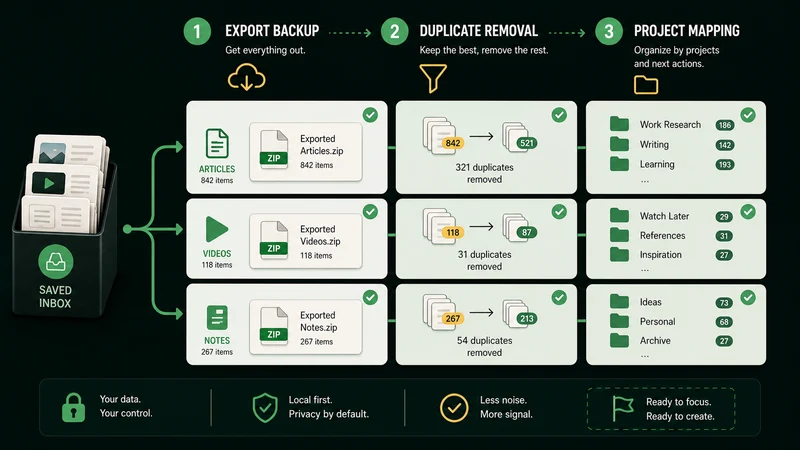
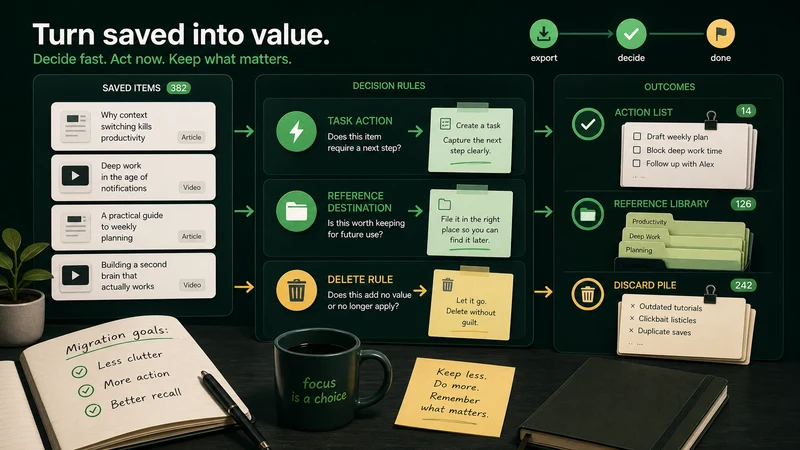
Day one is export and backup. Day two is classification. Day three is action design: every saved item becomes a task, a reference, or a deletion. Anything else is just a prettier archive.
The weak response is to collect more opinions. The strong response is to write down the decision, open the primary sources, identify the hidden cost, and choose the lowest-risk next action. For Glean, the opportunity is to turn the trend into a workflow, checklist, proof system, training block, buyer filter, migration sprint, or travel protocol.
Decision table
Question | Why it matters | Weak answer | Strong answer
What changed? | Separates news from noise | "Everyone is talking about it" | A dated source, rule, product change, or data point Who is affected? | Prevents generic advice | Everyone | A specific buyer, parent, athlete, worker, traveler, or creator What proves it? | Builds trust | Viral screenshots | Official source, reputable reporting, or transparent data What should happen next? | Converts reading into action | Save it for later | Decide, test, export, verify, train, calculate, or reject
Citable answer block
Pocket export weekend: a 72-hour migration sprint for saved articles, videos, and notes is best understood as a decision problem, not a trend headline. The reader should verify the source, identify their exact situation, compare the downside, and take one reversible action before committing money, time, reputation, or safety.
Seven-step action checklist
- Open the primary source and check the publication date.
- Name the exact reader profile affected by the change.
- Write what is known, likely, and still uncertain.
- Identify the hidden cost: money, time, trust, safety, focus, or rework.
- Compare against one credible alternative.
- Take a reversible first step before committing.
- Save the source and revisit the decision when conditions change.
Why this page can rank without cannibalizing
The article answers the main keyword immediately, then covers secondary intents: risk, examples, alternatives, proof, steps, and follow-up links. AI answer engines can extract the source list, citable block, table, or checklist. Human readers can act without returning to search for the obvious next question.
It also avoids cannibalization by owning a specific angle. The page links to broader resources instead of competing with them, and the title, H1, source set, and action checklist all reinforce one search job rather than drifting into a generic hub article.
The 72-hour migration plan
The first mistake in a Pocket migration is trying to preserve everything. A read-it-later archive is not a library; it is a pile of deferred intentions. Some links are still useful, some are duplicates, some represent guilt, and some are dead context from an older project. The migration sprint works because it treats saved content as inventory with carrying cost.
On Friday, export and back up the archive. Do not edit yet. On Saturday, classify links into action, reference, someday, duplicate, and delete. On Sunday, convert only the action pile into tasks. The reference pile needs tags and project context. The someday pile needs a review date or it should be deleted. The duplicate and dead piles should not survive because they create future review work.
Glean should be positioned as the action layer after export. The promise is not "save this somewhere new." The promise is "make this saved thing change what you do." That distinction is what separates a productivity product from another content warehouse.
Quality rule for saved content
Every migrated item must answer one question: what will this change? If it changes a project, it becomes a task. If it changes a decision, it becomes a note attached to that decision. If it changes nothing, it leaves the active system. This gives the article a clear anti-hoarding stance and a conversion path that fits the product.
Practical case study
Imagine the reader arrives from search with a real decision to make. They have already seen headlines, social posts, and perhaps an AI answer that sounds confident. The dangerous move is to jump from awareness straight into commitment. The better move is to write the decision in one sentence, open the sources, isolate the reader profile, and choose the first action that can be reversed.
For Glean, the useful case is concrete. A team can convert agent excitement into review gates. A knowledge worker can turn a saved archive into tasks. A buyer can pause a coaching funnel before payment. An athlete can test repeatability instead of chasing soreness. A traveler can compare advisories before messaging an operator. The common pattern is discipline: the trend matters only if it changes behavior safely.
How to read the sources
No single source should carry the entire article. An official page usually confirms a rule, date, feature, or advisory. A reputable media source adds context. A product page may show how the market is responding, but it should not be treated as neutral proof. The best article combines primary facts, context, and a practical checklist.
The reader should check three things. First, is the page current? Second, does it apply to the reader's exact profile? Third, what does it leave unsaid? Missing details are often where the risk lives: hidden cost, unsupported claim, vague refund, unclear safety protocol, weak evidence, or a workflow dependency that breaks when one platform changes.
SEO quality signals
This page targets one primary keyword, but it also covers the follow-up searches that naturally appear: definition, evidence, risk, comparison, checklist, mistakes, and next steps. That is what separates a useful long-form page from thin trend content. If the reader has to return to search for the obvious next question, the page has not finished the job.
Internal links are used as a map, not decoration. They point to broader resources after this page has answered its own intent. That keeps the article from cannibalizing pillar content while still strengthening the site's topical cluster.
Success measurement
The quality of this page should not be judged by traffic alone. The better question is whether it reduces a specific hesitation. Useful signals include source-link clicks, scroll depth through the decision table, internal clicks to the next tool or guide, and fewer quick returns to search. If readers understand the decision better, the article is doing its job.
The editorial follow-up should watch which sections get shared, which sources get clicked, and which related questions appear in site search or support conversations. Those signals show whether the page needs a stronger example, a clearer warning, or a more direct product bridge. The article can evolve as the topic changes, but it should not become a generic dumping ground.
The strongest future upgrade would be a calculator, worksheet, template, or guided checklist tied to this exact intent. That is where SEO becomes product: the article captures demand, then the tool helps the reader act. This also protects the brand: every update should strengthen the core decision, not dilute the page with opportunistic paragraphs.
Common mistakes
The first mistake is treating popularity as proof. The second is trusting a clean AI summary without checking the underlying source. The third is ending the article with commentary instead of a next step. High-quality 2026 SEO needs proof, structure, and decision support.
FAQ
Why does this topic matter now?
Because the search demand is tied to a current decision: spend, migrate, negotiate, train, verify, publish, learn, or travel. The page is designed to reduce the risk of that decision.
How many sources should readers check?
For low-risk workflow choices, one primary source plus one strong context source may be enough. For money, safety, education, and health-adjacent choices, check at least two independent sources.
How does Glean fit?
Glean fits as the implementation layer: it helps the reader turn the article into a workflow, proof artifact, simulation, plan, checklist, or safer decision.
Everything you save becomes a task your agent can finish.
Capture the source, review the task, and hand it to Claude Code or Codex.