AI Second Brain: What It Is and When It Helps
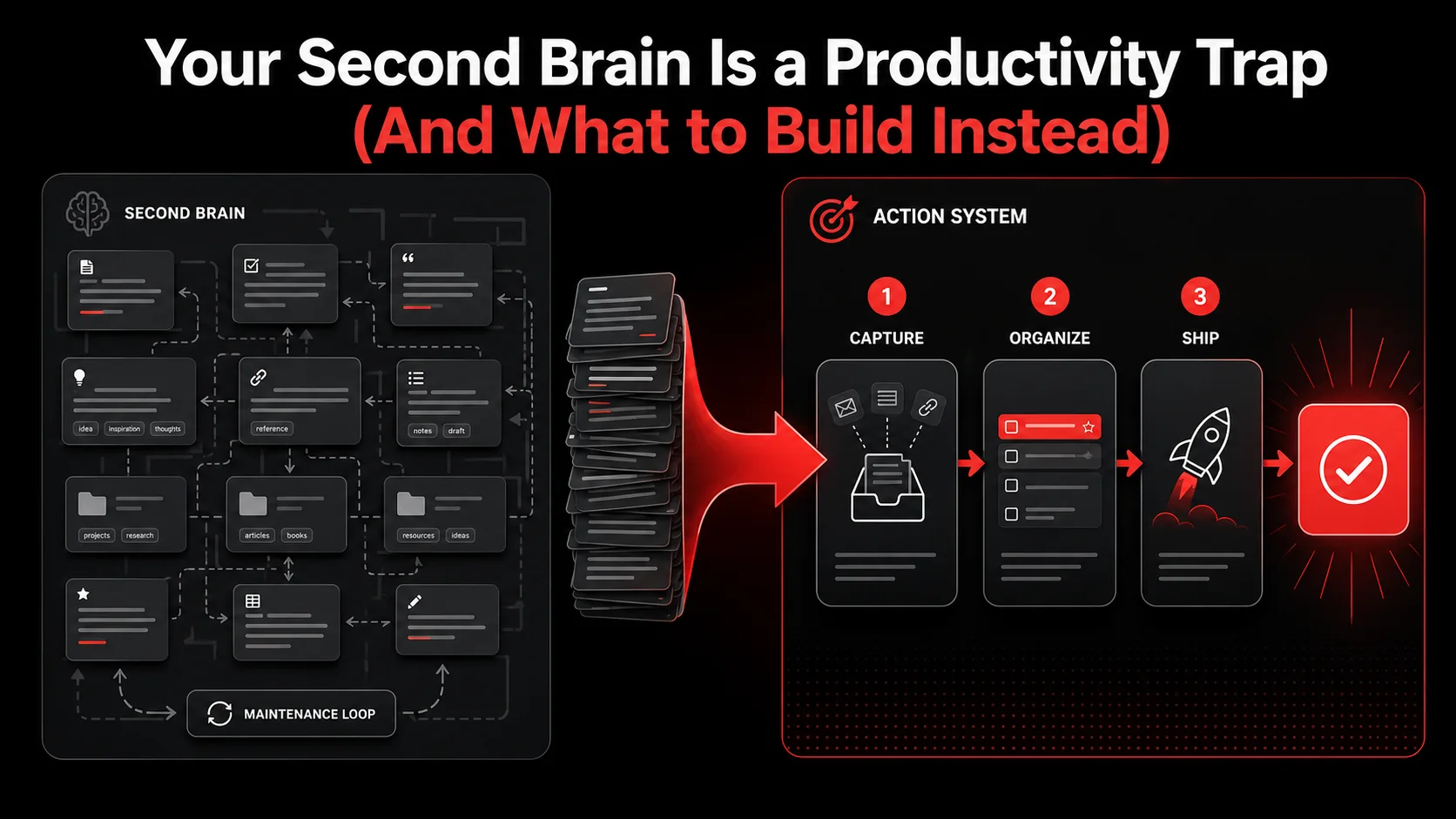
An AI second brain is a personal information system that uses artificial intelligence to help you capture, organize, retrieve, summarize, or transform material you want to use later. It can reduce the work required to find and reshape information. It cannot decide what matters to you, verify every generated statement, or complete the work merely because you saved the source.
The useful version connects knowledge to a real project or decision. The unhelpful version becomes a larger inbox with a chat box attached.
This guide is published by TryGlean, which makes a capture-to-action product, so treat our recommendations as interested and check the sources yourself. Our method here is deliberately plain: we read each primary document in full before quoting it, and every external claim below links to that document in the same sentence — Forte Labs for CODE and PARA, and NIST for the AI risk framework whose govern, map, measure, and manage functions we borrow. We separate the general method from our product and describe TryGlean's current scope explicitly below.
What makes a second brain an AI second brain?
According to Tiago Forte, a second brain is an external digital repository for ideas, insights, and resources. His official method uses four stages: Capture, Organize, Distill, and Express (CODE). It also emphasizes organizing information around active projects and turning knowledge into concrete results, not collecting notes for their own sake. See Forte Labs' Building a Second Brain overview and PARA guide.
AI can assist each stage:
| Stage | Ordinary system | AI-assisted system |
|---|---|---|
| Capture | You save a link, note, file, or image | AI can extract text, topics, or candidate actions |
| Organize | You choose folders, tags, or projects | AI can suggest a destination based on context |
| Distill | You highlight and summarize manually | AI can propose a summary, comparison, or checklist |
| Retrieve | You search by title, keyword, or folder | AI can answer a question across stored material |
| Express or act | You turn the material into an output | AI can draft a next step, but you still review and execute it |
The label is broad. A notes app with semantic search, a retrieval assistant over company documents, and a tool that turns saved content into tasks may all call themselves an AI second brain. The important question is not the label. It is the job the system performs reliably for you.
An AI second brain is not an automatic source of truth
An AI second brain is not a source of truth, and treating it as one is the fastest way to ship a wrong decision. AI output should remain a proposal until you verify it against the original material. A fluent summary can omit a limitation. A generated task can assume the wrong project. A confident answer can join details that the source never joined.
The NIST AI Risk Management Framework provides a useful general principle: organizations should govern, map, measure, and manage AI risks throughout use. For a personal knowledge system, that becomes a simple rule:
Keep the source attached, review the transformation, and make the final decision yourself.
Do not send confidential material to an AI service before checking its retention, training, sharing, and deletion terms. The correct privacy choice depends on the sensitivity of your material and the provider's current policy.
AI second brain, notes app, or action system?
These systems overlap, but they optimize for different outcomes.
| System | Best at | Weak point | Choose it when |
|---|---|---|---|
| Notes app | Writing and preserving your own thinking | Manual retrieval and maintenance can grow | You need durable notes, drafts, or reference material |
| AI second brain | Finding and transforming a larger information collection | Generated answers require verification | You repeatedly reuse information across questions or projects |
| Action system | Moving a defined next step toward completion | It is not a rich knowledge archive | Your main problem is execution, follow-up, or accountability |
You do not need to choose only one. A practical setup often uses a knowledge library for durable reference and an action system for work that must happen. The bridge between them matters more than the brand of either tool.
When an AI second brain helps
You need to reuse information across several projects
Reuse across several projects is the clearest case for a second brain.
An AI retrieval layer can help when you have a real body of material: research notes, meeting records, source documents, product decisions, or lessons from completed work. Ask a narrow question, inspect the cited material, and move the useful result into the current project.
The source is long, but the next decision is small
A long source with a small decision behind it is exactly what distillation is for.
A tutorial, report, or video may contain one change worth testing. AI can propose that change as a concise task while preserving a link to the source. You still check the relevant section before acting.
Your information arrives in inconsistent formats
Inconsistent formats are where AI capture earns its keep, because normalising them by hand is joyless.
Useful input may arrive as a web page, screenshot, video, message, or handwritten note. AI can normalize those formats into a common structure such as a title, context, source, and candidate next step.
You know what you want the system to produce
AI works better when the output contract is explicit. "Save this" creates an archive. "Extract the decision, show the supporting passage, and propose one next action for Project Atlas" creates something you can review.
When it becomes another productivity trap
You capture without a retrieval or action rule
If you cannot name when you will need an item again, saving it creates an obligation without a use. Selective capture beats an unlimited inbox.
You optimize the taxonomy instead of the work
Optimizing the taxonomy instead of the work is the failure mode with the best disguise.
Folders, tags, embeddings, prompts, and graph views can all help. They become a problem when maintaining them consumes the time reserved for the project they support.
You accept transformations without checking the source
An AI-generated summary is not evidence. Preserve the original URL or file, inspect material claims, and correct the task before it enters your queue.
You mix reference material with commitments
Mixing reference material with commitments turns one list into two jobs and does neither well.
"Useful someday" and "I must do this by Friday" require different treatment. Store reference material where you can retrieve it. Put commitments in a system with ownership, status, and a next action.
A five-step AI second-brain workflow
1. Define the output before choosing a tool
Write one sentence:
> When I save information, I want the system to help me produce ______.
Possible answers include a cited research note, a decision, a task, a draft, a lesson, or a reusable checklist. If you cannot complete the sentence, you are not ready to evaluate tools.
2. Capture selectively and preserve provenance
Save material because it supports an active question, responsibility, or project. Keep the author, original URL or file, publication date when relevant, and your reason for saving it.
3. Ask AI for a bounded transformation
Prefer a request you can inspect:
> Summarize the recommendation in this source, quote no more than needed, list its assumptions, and propose one next action. Mark anything the source does not establish.
This is safer and more useful than "Tell me everything important."
4. Review before the result enters your system
Open the source. Check the proposed action, names, numbers, dates, and limitations. Edit or reject the output. The AI saves preparation time; it does not own the decision.
5. Route knowledge and action separately
Keep durable insight in your knowledge library. Send the next action to the project where you will execute it. Link the two so you can recover the reasoning later.
Example: turn a saved tutorial into work
Suppose you save a tutorial about passkeys.
An archive-only flow ends with a bookmarked tutorial. A useful AI second-brain flow might produce:
- Source: the original tutorial;
- Verified takeaway: the specific implementation pattern you checked;
- Project: authentication upgrade;
- Next action: compare the pattern with your current sign-in flow;
- Decision record: adopt, reject, or investigate, with the reason.
Move one source into action with Glean
Glean is an action layer, not a complete replacement for a research library or a company knowledge base.
Today, Glean processes X posts, YouTube videos, and screenshots. It creates a reviewable task with context and keeps the source attached. Saved web and social links become action suggestions that you review. You can place the result in a project and edit it before relying on it.
That makes Glean useful when your bottleneck is the distance between "I should do something with this" and a task you can execute. If your primary need is long-term citation management, connected research notes, or querying a large private document collection, use a dedicated knowledge system and send only the actionable output to Glean.
Open Glean, save one source, review the proposed action, and place the todo document in the project where you will use it. See how content-to-task turns reading into action or compare the workflow with Notion Web Clipper.
How to evaluate an AI second-brain app
Use the same source and the same task with each candidate. Then check:
- Can you recover the original source without searching again?
- Does the system distinguish sourced text from generated interpretation?
- Can you correct the result before it changes your workflow?
- Does it support your real input formats and destination tools?
- Can you export or delete your information under terms you accept?
Frequently asked questions
Is an AI second brain just a notes app with AI?
An AI second brain is more than a notes app with AI bolted on, though plenty ship as exactly that.
Sometimes. The term has no single technical definition. The practical difference is whether AI materially helps you capture, retrieve, transform, or route information instead of merely adding a generic chat interface.
Can ChatGPT be an AI second brain?
ChatGPT can act as one, within limits worth naming.
It can help transform information you provide and, depending on the product configuration you use, retrieve connected material. Whether it functions as your second brain depends on source retention, retrieval, privacy, export, and how you connect answers to your real projects.
Do I still need folders and tags?
You still need folders and tags, just far fewer of them than you think.
Use them when they reduce retrieval time or clarify ownership. Do not maintain a taxonomy simply because the tool supports one. Search, links, projects, and a small number of stable categories may be enough.
Should every saved item become a task?
No, not every saved item should become a task.
No. Durable reference material can remain reference material. Create a task only when the source implies a decision, commitment, experiment, or next step you actually intend to perform.
What should I measure?
Measure the outcome named in your output sentence: decisions supported, tasks completed, drafts produced, or sources reused. Capture count alone tells you how much entered the system, not whether the system helped.
Share what you read. Get your next step.
Every save you share comes back as one task for your project, with the reason it fits you.